Showing posts with label economics. Show all posts

Friday, November 5

Interest rate WTF

Tyler Cowen:
What's in your wallet? Less if you use Firefox or IE and more if you use Chrome. Here from J-Walk Blog are interest rates for a car loan from Capital One if you use IE.
IERates
and here are the rates if you use Chrome:
Chrome
Consumerist: "Capital One Made Me Different Loan Offers Depending On Which Browser I Used"

Here's one commenter:
These are driven by statistics. I work in a group that does statistical analysis of web traffic, and any piece of information that is collected during a browser session is subject to analysis--including what browser you use. If statistical analysis of web traffic, correlated to account history, indicates that users of browser X are more likely to default or be a problem payer on a loan than users of browser Y, then that goes into the mix, and has absolutely nothing to do with the browser itself.

We analyze EVERYTHING: What bank your credit card is with, where you live, how many seconds you spend on each web page, how long your fargin' name is. Everything that can be analyzed IS analyzed, and correlations that give any 'lift' are folded into the lending process.
This could have flown under the radar if Capital One had decided to cache a history of previously-presented offers by IP address that expired after, say, six hours.

I doubt it was intentional, but the publicity this has generated on economics blogs must be good for them.

Thursday, October 7

Was TARP good for the taxpayers?

Mises concludes:
The TARP was crooked from the very start, using taxpayer funds to bail out some of the world's richest people from their own foolish investments. The claims that it made taxpayers money are unfounded. Even worse, TARP taught investment bankers an important lesson: During a boom, make as much money as you can, no matter how short-term the profits will be. When the bubble pops, the Treasury and Fed will be there with a taxpayer-funded pillow.

Why should we care about economic inequality?

Derek Thompson asks. I have the same question.

Wednesday, May 5

Esther Duflo at TED

The MIT Economist who won the John Bates Clark Medal:
The award is considered one of the most prestigious honors within economics [..] Many consider the Clark Medal to be a preview of future Nobel prizes, as 12 of the 31 prior Clark Medalists have gone on to receive the Nobel Memorial Prize in Economic Science (including Paul Krugman and Milton Friedman).
Here is a video of her talk on using randomized trials to evaluate which development policies work.

Sunday, May 2

Important sentences

"..a VAT is neither blessed nor evil. It is a tool. We can use it to advance a larger government, a more efficient tax system or some combination of the two."

—Greg Mankiw in the Times.

"...America's not very good at dealing with slow-moving crises, even with slow-moving solutions. We're much better at waiting until a crisis happens, acting quickly, and then putting together commissions to find out why nobody saw it coming."

—Derek Thompson, Atlantic Business.

Wednesday, March 31

Monday, March 8

An open letter to President Obama

8 March 2010

Mr. Barack Obama
President, Executive Branch
United States Government
1600 Pennsylvania Ave., NW
Washington, DC  20500

Dear Mr. Obama:

CBS radio news this morning ran a clip of one of your recent speeches.  In it, you criticize insurance companies because they “ration coverage … according to who can pay and who can’t.”

My first thought was “not exactly; coverage is rationed according to who pays and who doesn’t.”  Ability to pay isn’t the same thing as actually paying, and what insurers care about is the latter.  Many folks – especially young adults – have the ability to pay but choose not to do so.  They get no coverage.

But further pondering of your point leads me to look beyond such nit-picking to see fascinating possibilities.  Not only insurers, but all producers who greedily refuse to supply persons who don’t pay should be set aright.  Now I’m sure that you don’t ration the supply of the books you write according to any criteria as sordid as requiring people actually to pay for them.  But our society is full of people less enlightened than you.

For example, the typical worker rations his labor services according to who pays and who doesn’t.  That must stop.  Oh, and supermarkets!  Every single one rations groceries according to who pays.  Likewise with restaurants, clothing stores, home-builders, furniture makers, even lawyers!  You name it, rationing is done according to who pays.  Indeed, my own county government has been corrupted by this greedy attitude: if I don’t pay my taxes, the sheriff takes my house – effectively booting me out of the county merely because I didn’t pay for its services.

Preposterous!

I look forward to your changing this selfish and unfair system of rationing that for too long now has kept Americans impoverished.

Sincerely,
Donald J. Boudreaux
Professor of Economics
George Mason University
Fairfax, VA 22030

Wednesday, March 3

How did the financial crisis happen?

Via Mankiw:
Yale economist Gary Gorton offers a very readable Q&A explaining his view of recent events. (.pdf)
It's sixteen pages and well worth the read--print it out in color if you can.

Friday, February 12

Making the case for child labor and sweatshops

Economist Steven E. Landsburg:
"As any historian could tell you, no society has every pulled itself out of poverty without putting its children to work. Back in the early 19th century, when Americans were as poor as Bangladeshis are now, we were sending out children to work at about the same rate as the Bangladeshis are today.

Having had the good fortune to get rich first, Americans can afford to give Bangladeshis a helping hand, and there are plenty of good ways for us to do that. Denying Third Worlders the very opportunities our ancestors embraced, whether through full-fledged boycotts or by insisting on health and safety standards they can’t afford to meet, is not one of those ways."
There's more from him on closing sweatshops.

I recently read Landsburg's The Big Questions: Tackling the Problems of Philosophy with Ideas from Mathematics, Economics, and Physics--it's fascinating.

(ht Perry)

Friday, February 5

Econ comedy

On the prestigious PBS News Hour--where else?

Thursday, December 10

"Take away their shovels and give them spoons"

Cato explains job creation.

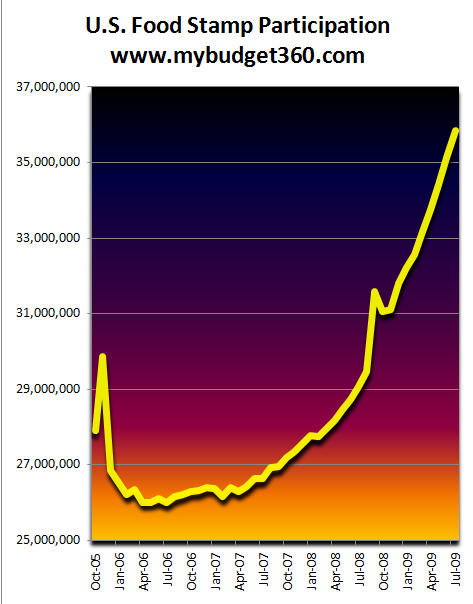
Chart of the day


But do note that it's misleadingly based at 25 mil.

NYT: "one in eight Americans and one in four children" receive food stamps.

I suppose that if we were to replace all welfare with a negative income tax, as I advocate, some of the resulting tax credit for low earners could be provided in the form of food stamps if we're worried that too much of the money is wasted on non-food items.

(ht nc)

Types of global warming skepticism

A dish reader writes:
The problem with your reader's simplification of the AGW deniers' argument is that he's speaking very generally and generously about one small battalion in a broad coalition of deniers.

We have the supposedly literate folks like George Will who don't understand what a trend is, and therefore they think the Earth has been cooling since 1998, ergo AGW is a hoax. Then we have the folks who think that the Earth may indeed be warming, but it's not because of human activity, or if it is, the absolute proof hasn't been found yet. Then we have the folks who think that it's too late, too hard, and too expensive to do anything about it, so, oh well, we'll deal with it and we'll "evolve." Then we have the Christian right, which thinks that God sets the thermostat, period, and scientists are evil ghouls who bring about things like the Holocaust. Then there are the worshipers of "common sense" who think it's a stroke of genius to say things like "carbon dioxide only makes up a tiny percentage of the atmosphere." And let's not forget the paranoid viral email forwarders who think that the East Anglia story is evidence of a genuine conspiracy fronted by Al Gore that seeks to make money by setting up carbon offset programs. And on and on and on.

It's a vast army of millions that is supported by the apathy of millions of others who, understandably, don't know what to think. The common bond is denial, and the common goal is to do absolutely zilch to change our habits.
Bold is my flavor. I further suspect that models of warming's deleterious effects are more uncertain and exaggerated than those sounding the alarm will admit, and am also not fully convinced temperatures are at a significant high compared to a millenia ago (pre-Little Ice Age).

I'm not against a Pigovian framework to reduce unnecessary emissions, but I insist that it be done in an economically efficient manner so that we're not wasting resources and can be sure it passes cost-benefit muster.  There are worse things than doing nothing--a convoluted giveaway to special interests like Waxman-Markey, for instance.

Quote of the day

"If the people that believed the moon landing was staged on a movie lot had access to unlimited money from large carbon polluters or some other special interest who wanted to confuse people into thinking that the moon landing didn't take place, I'm sure we'd have a robust debate about it right now." —Al Gore

Well there are other differences. No one is proposing drastic economic changes on the basis of the moon landings being faked. You can't pin the entire debate on people with a particularly strong vested interest in pollution (say, oil and coal companies). There are other things at stake.

Thursday, December 3

Sentences to ponder

This comes via MR:
Remember too that when you have a progressive tax system, especially when there are surcharges on people making seven-figure incomes, you also have a system where for any given level of national income, the greater the inequality, the greater the government’s tax revenues. And indeed federal revenues have been rising faster than median wages for decades now, thanks to the rich getting ever richer.

Given the government’s insatiable appetite for cash, it’s only natural that it would prefer to tax plutocrats, spending some of that money on poorer Americans, rather than move to a world where poorer Americans earn more (but still don’t pay that much in taxes), and the plutocrats earn less, depriving the national fisc of untold billions in revenue.

The government’s interests, then, are naturally aligned with those of the plutocrats — and when that happens, the chances of change naturally drop to zero.
Even yet another reason to support a flat tax.

Saturday, November 28

Pigovian economics

WSJ - Mr. Pigou's intellectual legacy is being rediscovered, and, unlike those of Messrs. Keynes and Friedman, it enjoys bipartisan appeal. Leading Republican-leaning economists such as Greg Mankiw and Gary Becker have joined Democrats such as Paul Krugman and Amartya Sen in recommending a Pigovian approach to policy. Much of President Barack Obama's agenda—financial regulation, cap and trade, health care reform—is an application of Mr. Pigou's principles. Whether the president knows it or not, he is a Pigovian.

Mr. Pigou pioneered the study of market failure—the branch of economics that explores why free enterprise sometimes [fails]. During the 1930s, Mr. Keynes lampooned him as a reactionary because of his suggestion that the economic slump would eventually recover of its own accord.

But while Mr. Pigou believed capitalism works tolerably most of the time, he also demonstrated how, on occasion, it malfunctions. His key insight was that actions in one part of the economy can have unintended consequences in others.

(continued)

Tuesday, November 24

The misery index

Wikipedia:
The misery index is an economic indicator, created by economist Arthur Okun, and found by adding the unemployment rate to the inflation rate. It is assumed that both a higher rate of unemployment and a worsening of inflation create economic and social costs for a country.

[..] During the Presidential campaign of 1976, Democratic candidate Jimmy Carter made frequent references to the Misery Index, which by the summer of 1976 was at 13.57%. Carter stated that no man responsible for giving a country a misery index that high had a right to even ask to be President. Carter won the 1976 election. However, by 1980, when President Carter was running for re-election against Ronald Reagan, the Misery Index had reached an all-time high of 21.98%. Carter lost the election to Reagan.
A graph of changes in misery during presidential terms, via Cato:


This seems to jive with common wisdom about recent presidents: Reagan and Clinton were good, Carter was terrible, and the Bushies were mostly neutral.

Naturally, any metric that values reductions in inflation is going to make Reagonomics look good.  Presently we're working our way out of a deflationary recession, so the usual rules don't apply; some more inflation would actually be good right now (and help bring up employment to boot).

Tuesday, November 10

The dead zone: implicit marginal tax rates on the working poor

A look at our awful system:


Mises Daily explains:
At A, the marginal tax rate is quite high, essentially because of the generosity of the package of cash and noncash benefits provided to those on welfare. At B, the marginal tax rate is relatively low (!) because of the Earned Income Tax Credit (EITC). From B to D, we (or, rather, the working poor) are in the Dead Zone, with implicit marginal tax rates mostly exceeding 100 percent.

How stupid and evil must our elected representatives be to do this to the working poor! Actually, this being a democracy, there is nobody to blame but the electorate. Especially the left-liberal do-gooders. Since Milton Friedman developed the negative income tax, waaay back in the 1950s, there can be no excuse for any educated person to not be aware of the fact that taxes and means-tested benefits destroy the lower classes' positive incentive to work.

At C, the implicit marginal tax rate is momentarily "only" 75 percent. This is because, in the face of losing other means-tested benefits while the federal income tax kicks in, the children of the household still qualify for the State Children's Health Insurance Program (SCHIP). The lull in the onslaught is momentary, however, ending as soon as that prop is removed from the household.

At D, the family is finally done with jumping through the hoops to qualify and remain qualified for the give-away programs. Now all it has to concern itself with is paying taxes. But there is no rest for the weary because, at E, the child tax credit phases out.

In the above scenario, I describe the effects of the tax and subsidy programs of the government with respect to a hypothetical family of three, consisting of one adult and two minors, with a focus on the working poor. I could just as well have talked of a middle-class family with one or more children of college age, and how means-tested financial aid programs such as the Pell Grant and federally subsidized loans make fools of those who save for college; or how Medicaid's rules for nursing-home eligibility make those who save for retirement into fools; or how bringing back the pre-Reagan tax rates will make utter fools of families in which the wife and husband both work.

Everywhere, the government's desire (meaning the left-liberal do-gooders' desire) to be generous to the poor is destroying the positive incentives to work and to save that are so necessary for a well-functioning economy. What they have done to Detroit, and are doing to New Jersey, they will do to the entire country.
(via Marginal Revolution)

Sunday, November 1

Implicit marginal tax rates, again

Greg Mankiw writes in the Times and discusses:
A family of four with an income, say, of $54,000 would pay $9,900 for health care. That covers only about half the actual cost. Uncle Sam would pick up the rest.

Now suppose that the same family earns an additional $12,000 by, for example, having the primary earner work overtime or sending a secondary worker into the labor force. In that case, the federal subsidy shrinks, so the family’s cost of health care rises to $12,700.

In other words, $2,800 of the $12,000 of extra income, or 23 percent, would be effectively taxed away by the government’s new health care system.

That implicit marginal tax rate of 23 percent is a significant disincentive. And it comes on top of the explicit marginal tax rate the family already faces from income and payroll taxes. Altogether, many families would face marginal rates at or above the 50 percent level that animated the Reagan supply-side revolution.

[..] there is no simple fix. Higher marginal tax rates are an integral part of the Obama health plan.